A Modern, Conservative Approach to a Beautiful Smile
Minimal‑prep veneers remove only 0.2‑0.5 mm of enamel, while no‑prep (ultra‑thin) veneers require little or no reduction at all, preserving the tooth’s natural structure. Both options are custom‑designed porcelain shells that bond directly to the enamel, delivering a natural‑looking, stain‑resistant smile with minimal discomfort. Patients benefit from reduced postoperative sensitivity, often no anesthesia, fewer appointments—sometimes a single visit—and a quicker return to normal eating and speaking. The conservative approach also safeguards long‑term tooth strength and makes future dental work easier. Laguna Beach Dental Arts enhances these advantages with digital smile design, AI‑assisted 3‑D scanning, and CAD/CAM milling, allowing precise mock‑ups, exact shade matching, and same‑day fabrication. This technology‑driven workflow ensures a perfect fit, maximizes enamel preservation, and provides patients a confident, efficient, and comfortable path to a radiant smile.
Understanding Minimal‑Prep vs. No‑Prep Veneers
Minimal‑prep veneers remove a small amount of enamel—typically 0.3‑0.5 mm—allowing a precise fit and the ability to correct moderate discoloration, chips, or gaps. This preparation is enough to shape the teeth for optimal translucency while preserving most of the natural structure.
No‑prep veneers are ultra‑thin, ranging from 0.2‑0.5 mm, and bond directly to unaltered enamel, eliminating the need for drilling and often avoiding local anesthesia.
Clinically, minimal‑prep veneers are indicated for patients with mild to moderate aesthetic concerns who still require a sturdier, longer‑lasting restoration (10‑15 years). No‑prep veneers suit cases with minor cosmetic tweaks—light stains, tiny gaps, or subtle shape adjustments—and provide an instant, natural‑looking smile with a shorter treatment timeline, usually a single visit. Both types are custom‑designed using digital smile design and AI‑assisted imaging to match color, translucency, and shape, delivering seamless integration with surrounding teeth.
What is the difference between minimal prep and no‑prep veneers? Minimal‑prep veneers need a slight enamel reduction (0.3‑0.5 mm) for a precise fit and larger corrections; No‑prep veneers are ultra‑thin (0.2‑0.5 mm) and bond without any reduction, ideal for minor aesthetic tweaks.
No‑prep veneers before and after Before placement, a digital scan captures the existing tooth morphology; after bonding, the smile is instantly transformed with seamless color and translucency, and patients report little to no sensitivity.
No‑prep veneers vs traditional veneers No‑prep veneers are thinner, require no enamel removal, and are completed in a one visit, but last 5‑10 years. Traditional veneers involve more reduction, allow greater shape change, and typically last 10‑20 years.
What is the 4‑8‑10 rule for veneers? It is a planning guide: “Four” central incisors, “Eight” adds canines for a balanced front‑to‑side view, and “Ten” includes first premolars for a broader, symmetrical smile line.
Comprehensive Cosmetic Options at Laguna Beach Dental Arts
Most Popular Cosmetic Dental Procedures
Patients at Laguna Beach Dental Arts most often choose professional teeth‑whitening, porcelain veneers (ultra‑thin ceramic shells that reshape, recolor, and close gaps), composite bonding and veneers for affordable, minimally invasive repairs of chips, cracks, and small gaps, clear‑aligner therapy for discreet orthodontic correction, and laser gum‑contouring to balance an uneven gum line.
Dental Restoration Types
Restorations are divided into direct and indirect categories. Direct restorations—such as composite or amalgam fillings—are placed directly in the mouth in a single visit. Indirect restorations—including onlays, inlays, crowns, bridges, implants, and dentures—are fabricated in a dental laboratory and later bonded or cemented to the tooth. Cosmetic‑focused indirect restorations, like veneers, provide both aesthetic improvement and functional support.
Why Do Dentists Advise Against Veneers?
Clinicians may recommend alternatives when veneers would jeopardize long‑term oral health. Situations include extensive decay, active gum disease, or extremely thin enamel that cannot sustain a reliable bond. Permanent enamel removal can increase sensitivity, and veneers do not address underlying issues such as weak tooth structure or bruxism. High cost, the need for diligent maintenance, and the inability to change shade after placement also limit suitability, prompting dentists to suggest more conservative options like bonding, crowns, or orthodontic treatment.
How Minimal‑Prep Veneers Fit Into the Broader Treatment Plan
Minimal‑prep (or no‑prep) veneers preserve the majority of natural enamel, reducing postoperative sensitivity and often eliminating the need for local anesthesia. Their thin design (0.2‑0.5 mm) allows them to be bonded directly to unaltered enamel, typically in one or two visits using digital scanning and CAD/CAM fabrication. Because the procedure is conservative, it integrates smoothly with other cosmetic services—such as whitening, clear‑aligners, or gum‑contouring—offering a comprehensive, minimally invasive smile makeover while maintaining long‑term dental health.
Patient Considerations, Eligibility, and Costs
When deciding on minimal‑prep veneers, patients first look at the financial picture. The price of a minimal‑prep or no‑prep veneer ranges from $800 to $2,500 per tooth, with a national average of $1,200‑$2,000. Brands such as Lumineers®, DURAthin® or Vivaneers® fall within this range, while a full‑smile makeover can total $8,000‑$30,000 depending on the number of teeth, imaging, and any preparatory work. Laguna Beach Dental Arts offers itemized quotes, financing plans, and same‑day emergency appointments to help manage expenses.
Eligibility hinges on oral health and aesthetic goals. Ideal candidates have healthy enamel and gums, with minor cosmetic concerns such as mild discoloration, small chips, or gaps up to 2 mm. The dentist evaluates tooth condition, alignment, existing restorations, and any decay or gum disease before recommending a minimal‑prep approach. Minimal‑prep veneers require removal of only 0.2‑0.5 mm of enamel, preserving most of the natural tooth structure, the procedure is often painless, requires little or no anesthesia, and preserves the tooth’s structural integrity.
Statistically, fewer than 10 % of adults retain a full set of natural teeth by age 70, with roughly 7‑9 % keeping all 28‑32 teeth. This underscores the importance of conservative, enamel‑preserving options like minimal‑prep veneers, which can extend the functional life of existing teeth while delivering a natural‑looking smile.
Technology‑Driven Workflow and Treatment Efficiency
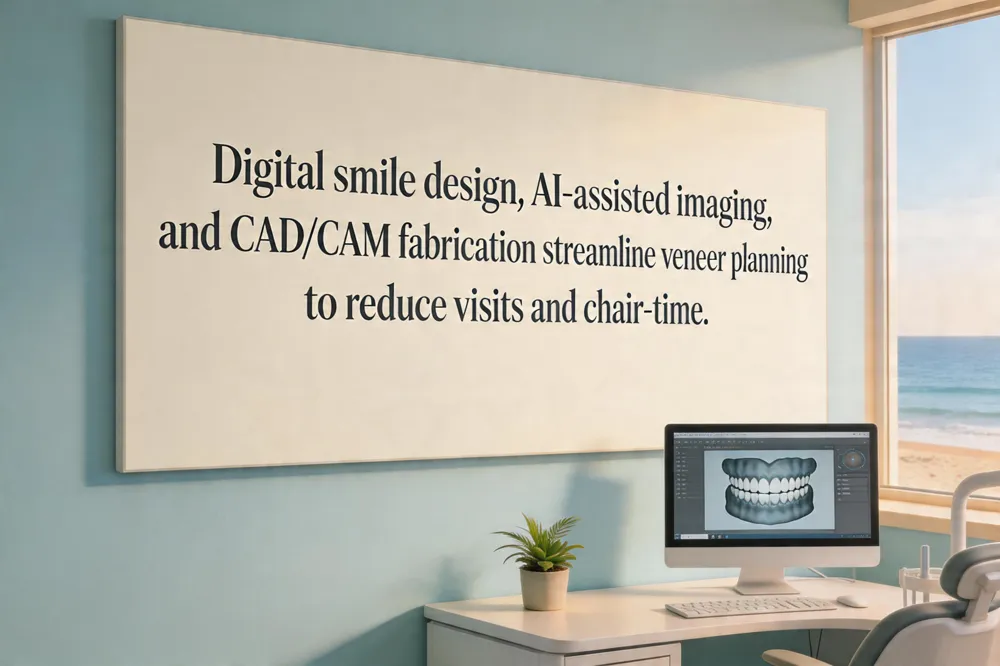
Digital smile design and AI‑assisted imaging have become the backbone of modern minimal‑prep veneer therapy. By capturing a 3‑D intra‑oral scan and applying AI‑driven shade‑matching and mock‑up software, dentists can preview the final smile before any enamel is touched, ensuring precise shade, shape, and translucency. This virtual planning eliminates guesswork, reduces the need for provisional restorations, and allows the laboratory to fabricate ultra‑thin veneers in a single CAD/CAM cycle. Because the design is finalized digitally, the entire treatment can often be completed in two visits—or even one in practices with chair‑side milling—cutting chair‑time by up to 30 minutes per tooth compared with traditional protocols that require 3‑4 appointments. Fewer visits and the absence of drilling translate into a far more comfortable experience: patients report minimal postoperative sensitivity, reduced anxiety from avoiding needles and drills, and a smoother, quicker path to a natural‑looking smile.
Maintenance, Oral‑Health Habits, and Long‑Term Success
Proper care begins with the 3‑3‑3 rule: brush three times daily, three minutes each session, and replace the brush every three months. For veneers, follow the 4‑8‑10 guideline—four central incisors, eight adding canines, ten including first premolars—to plan a balanced smile. Routine veneer maintenance includes gentle brushing with a soft‑bristle toothpaste, flossing, avoiding abrasive foods, and six‑month check‑ups. Laguna Beach Dental Arts uses digital smile‑design previews and AI‑assisted education tools to show patients optimal hygiene techniques and long‑term care plans for lasting results today.
Choosing the Right Path to a Healthy, Radiant Smile
At Laguna Beach Dental Arts, we blend cutting‑edge digital smile design with minimal‑prep veneer techniques to keep as much natural enamel as possible while delivering a vibrant, natural‑looking smile. By evaluating each patient’s tooth condition, alignment and aesthetic goals, we customize a plan that balances beauty with long‑term tooth preservation. Our team also emphasizes daily brushing, flossing, regular cleanings and the use of fluoride to sustain oral health, ensuring the new smile stays healthy and radiant for years to come and confident everyday maintenance.